Monday, 30 December 2013
Thursday, 26 December 2013
Tuesday, 29 October 2013
.
The Haiku Society of America has just awarded my haiku below, a 'Museum of Literature Award'
.
.
.
silence of snow
we listen to the house
grow smaller
.
.
.
I had also gained the award previously, for a haiku published in Blithe Spirit, the British Haiku Society's journal...........
.
.
.
our old garden chairs
held together
by sunlit webs
.
.
.
The Haiku Society of America has just awarded my haiku below, a 'Museum of Literature Award'
.
.
.
silence of snow
we listen to the house
grow smaller
.
.
.
I had also gained the award previously, for a haiku published in Blithe Spirit, the British Haiku Society's journal...........
.
.
.
our old garden chairs
held together
by sunlit webs
.
.
.
Wednesday, 1 June 2011
In a New Garden new book reviewed by Pat Prime
.
(Please ignore the dotted lines in the haiku, this blogging format insists on removing spaces and justifying on the left, like it or not. The dotted lines are the only way of showing the haiku roughly as they should be, sorry. John)
New Book out. "In a New Garden" published by ALBA 96 pages ISBN:978-0-9572592-6-3 obtainable from ALBA Publishing PO Box 266, Uxbridge, UB9 5NX, UK www.albapublishing.com
UK £12.00 / US$16.00 / Euro15 plus p&p.
What people have said about In a New Garden:
In this beautiful collection John Parsons offers a sharp eye for detail a skillful sense of cadence
and an adept command of poetic possibilities He has an astute engagement with themes such
as seasons nature and human nature Parsons haiku are variously lucid deft and shrewd; while
several are humorous He chooses his words with care and his haiku are both eloquent and
evocative He demonstrates a sound use of form and his writing is well crafted and technically
excellent This is a rich and rewarding collection resonant with Parsons carefully wrought
language and imagery so often surprising and memorable D @ Patricia Prime Kokako
John Parsons does an interesting experiment with haiku He places a blank space in the middle
of a line This is so unusual that at first I doubted its effectiveness but now I am convinced that
this technique heightens the poetic quality of his haiku It works mainly in two ways: first it
gives psychological and emotional depth to his haiku and second it frees his haiku from rigidity
His technique performs the role which traditionally kireji is expected to do only more quietly
and with greater subtlety D @ Prof Noboyuki Yuasa
Published by LABYRINTH PRESS, 2010, 130pp ISBN: 897 1-87488 83 9. Obtainable from the author : LION HOUSE, 5 Unicorn Yard, Aylsham, Norfolk, NR11 6AU, UK. To all countries outside the UK $8 US in notes. UK £6 plus £2 pp.
I have admired John Parsons' haiku for many years, reading it in Blithe Spirit, Presence, Kokako and other magazines. Parsons is also an artist and his drawings regularly decorate the front cover of the UK publication Blithe Spirit. This is a beautifully published collection, comprising over 350 haiku and one haibun. Numbers are limited so be in early to obtain this lovely publication.
Parsons brings an artists eye to many of his haiku in which he observes the finer points of daily life, or the amazing beauty of nature:
-----wind over dry reeds
------------the harrier's shadow
--------------------------stills buntings
-----mantling wind
---------------the wings
----------------------of a hawk
His artistry is also applied to the format of his haiku: Here the poems are formatted in the traditional three lines, but his indentations vary and caesures may appear mid-line in either the first or second lines:
-----darkness-----the sound
--------------of quiet rain
---------------------sinks down
-----dancing on summer's
------------thread-----a crane fly
-----------------------shortens the days
This enables the reader to pause between the phrases and to register the emotions. Parsons seldom uses pronouns, so the haiku are left open to the reader's imagination. Where he does use them, they seem quite discreet:
---------new bag
-----she looks at herself
------------------with it
I think the quality of Parsons' haiku draws one into the variety of techniques and themes he uses. His themes are those of nature, family, everyday "happenings" and observations about human nature. The interweaving of the themes of the haiku creates a sense of how these moments of time can be captured in three lines, leaving much to the imagination, rather than be written as prose where everything is explained.
------teenage hips
------------swing in time
------------------until ring tones
Any doubts about the potential power of the haiku should be eradicated as Parsons imbues his work with so much of his personality that it's hard to think he could write in any other way. His voice is an instrument or tonal tool used with vivid effect. The results are considerable and effective, as we see in the following haiku.
------her breasts under
-----------black satin a loosely
------------------disguised double bed
------summer afternoon
------------a fart eases
-------------------through wicker
Parsons has achieved a stunningly convincing collectio of haiku that is entertaining, often funny and sometimes compassionate.
-------his postcard
----------------the gaps
----------------------say more
Arguably, the most arresting material comes in the haibun "For Rose", an elegy for a friend whose "death was sudden and unexpected". Here Parsons delves deep into his feelings for a woman he knew "only for a short while". The haibun ends:
Now, after the funeral, amongst the trees she loved, a few friends holding hands. We stand silent but for the sound of birds, holding her gently, linking thoughts.
------in hazel-----quivering
-----------a flat web holds
--------------------a film of ash
Parsons' haiku are consistently intriguing, his rhythms and phrasing impeccable. There is an impressive meticulousness of emotional observation and a precision in word placement that makes this book a must for both inexperienced and experienced haiku readers and writers.
.
(Please ignore the dotted lines in the haiku, this blogging format insists on removing spaces and justifying on the left, like it or not. The dotted lines are the only way of showing the haiku roughly as they should be, sorry. John)
New Book out. "In a New Garden" published by ALBA 96 pages ISBN:978-0-9572592-6-3 obtainable from ALBA Publishing PO Box 266, Uxbridge, UB9 5NX, UK www.albapublishing.com
UK £12.00 / US$16.00 / Euro15 plus p&p.
What people have said about In a New Garden:
In this beautiful collection John Parsons offers a sharp eye for detail a skillful sense of cadence
and an adept command of poetic possibilities He has an astute engagement with themes such
as seasons nature and human nature Parsons haiku are variously lucid deft and shrewd; while
several are humorous He chooses his words with care and his haiku are both eloquent and
evocative He demonstrates a sound use of form and his writing is well crafted and technically
excellent This is a rich and rewarding collection resonant with Parsons carefully wrought
language and imagery so often surprising and memorable D @ Patricia Prime Kokako
John Parsons does an interesting experiment with haiku He places a blank space in the middle
of a line This is so unusual that at first I doubted its effectiveness but now I am convinced that
this technique heightens the poetic quality of his haiku It works mainly in two ways: first it
gives psychological and emotional depth to his haiku and second it frees his haiku from rigidity
His technique performs the role which traditionally kireji is expected to do only more quietly
and with greater subtlety D @ Prof Noboyuki Yuasa
In a New Garden: haiku by John Parsons. Oxbridge, UK. Alba Publishing.www.albapublishing.com.
(2012) Pb. 96 pp. ISBN 978-0-9572592-6-3. UK12.00 / US$16.00 / €15.Reviewed by Patricia Prime
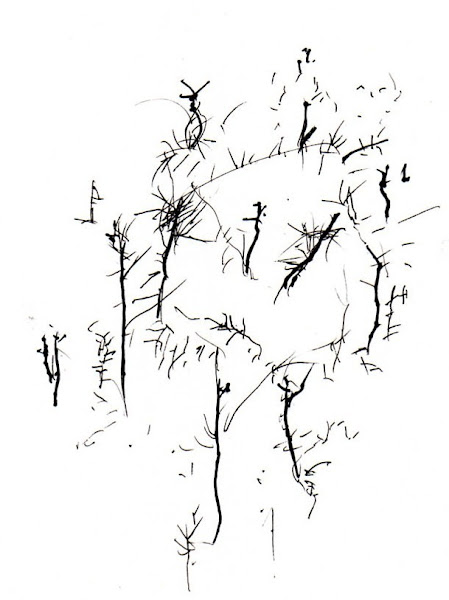
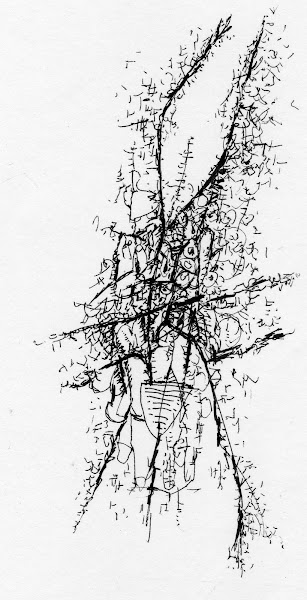
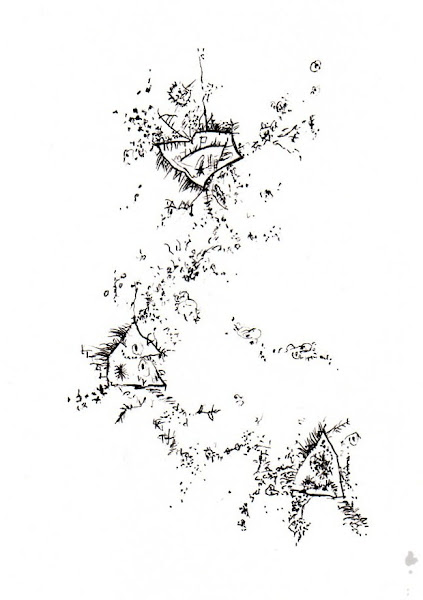
I was delighted when asked to write a comment for the jacket of John Parsons’ latest collection of haiku In a New Garden and, declaring this; I am equally pleased to review the work since I consider it to be one of the finest collections of haiku I have read. In his Preface to this fifth collection of haiku, Parsons writes, “This book is largely extracted from work over the past year, a time of upheaval and resettlement.” The book is divided into the seasons of the year; each season being prefaced by one of Parsons’ drawings.
The haiku are set out three to a page, in indented lines, with plenty of space around them. If you enjoy haiku, here is a volume full of delights and surprises. The strength, energy and compassion of Parsons’ haiku are impressive, and it is reader-friendly without ever being shallow. He brings a wealth of meticulous observation and personal experiences to his writing, through which we are better able to recognize ourselves and our surroundings. He invites the reader to share his vision and knowledge, and to discover with him, both human nature.
As I read and reflect on Parsons’ haiku, in all four sections of the seasonal year, I realize how the many layers of meaning of those title words – Spring, Summer, Autumn, Winter – are embedded in this collection, adding to its depth and the way the haiku work on the reader’s imagination.
The book opens with the section Spring. In the first haiku, we are with the poet in his “new garden” watching the unfolding snowdrops:
sense of belonging
snowdrops open
in a new garden
Parsons writes empathetically about new growth, flowers, bird’s eggs, the weather and the song of birds:
somewhere
lost in mist the robin
finds a song
this neatly sums up his interest in birds and their habitats. Moment after moment is described in meticulous detail, as we see in the following two haiku:
her book of symptoms
tulips writhe
against cut glass*in watery light
the whole meadow
webbed
By the closing poem of this section, the poet, fully aware of his own blessings, is able to give a “coin for the busker” and to hear him burst into song.
Parsons is a poet who has studied and practices drawing, printmaking, sculpture, songwriting and illustration and he has an instinctive understanding of line and form, and sensitivity to the music
of words. In the section Summer, for example, he writes
released lacewing
slow slant of glitter
lost in light*patch of moonlight
slips from her robe
the midnight room
each haiku having a fine feeling both of the musical and the “painterly” about them. Here we see “the moment under the moment”, the past that’s always there beneath the present.
Parsons seems to enjoy taking leaps to link ideas in unpredictable ways. In this section, for instance, he juxtaposes a dry beech mast to a baby toad, a stoat with a bow wave of rabbits, perennial leeks to random thoughts. Birds are clearly a passionate interest and fertile material for a number of haiku, among them a wren, a buzzard, gulls, pigeons, swallows and a goldfinch. As well as other fine haiku, including the beautiful
scent garden
for the blind roses feel ways
over the path
then there is his powerful
daughter returns
a goldfinch alights
on wizened marguerites
In section three Autumn, there are Parsons enthralling haiku about making love, All Hallow’s, the death of a friend, a hospital waiting room. The heart-wrenching
moonlight where she died
a ghost’s weight
on my shadow
Parsons demonstrates an unerring sense of voice in these autumnal poems in which he presents “rust-coloured chrysanths”, “shortening days”, “shriveled fronds”, but in all his work he subtly matches voice to mood and subject matter, as in the following haiku
beating heart
of silence a goldfinch
amongst cornflowers
where his minute observation is a compelling drive.
In the final section Winter, the haiku range across many subjects, from those about day-to-day things such as “lipstick smudges”, a “smart phone”, “new gloves”, to haiku about a value store, Christmas, snow and the lovely
tears on a greeting
where does she start
to wrap up a life
His desire to make a detailed study of the seasons seems to find its ultimate expression in the haiku
ice shards spread
in the oxbow’s curve cracks
of a woodman’s fire
Densely packed with vivid image after image, the moment-by-moment thoughts and minutiae of life
flow elegantly down the pages. There are so many fine haiku to indulge in – the memorable lines of
family heirloom
in the unfinished quilt
her last faltering stitch
and there are other beautiful, sensual and imagistic haiku too; the compassion and empathy of
“joints stiffen / every elbow of twisted hazel / a nodule of ice”, the indelible image of “just enough light / the robin’s breast / gives dead nettles life” and “loneliness / evening sun on the seat / never sat on”.
Whatever he writes about, Parsons always remains connected with the natural world and is sustained by it and even when he probes darker subjects, the sense of wonder it inspires shines through. He uses language powerfully to make us experience the world as he does, to hear birdsong, to feel the sun or the cold, to smell perfume or to sense the pain of stiff joints. His haiku shimmer with light, movement and colour, with sensual images that stay in the mind long after the book is closed.
Published by LABYRINTH PRESS, 2010, 130pp ISBN: 897 1-87488 83 9. Obtainable from the author : LION HOUSE, 5 Unicorn Yard, Aylsham, Norfolk, NR11 6AU, UK. To all countries outside the UK $8 US in notes. UK £6 plus £2 pp.
I have admired John Parsons' haiku for many years, reading it in Blithe Spirit, Presence, Kokako and other magazines. Parsons is also an artist and his drawings regularly decorate the front cover of the UK publication Blithe Spirit. This is a beautifully published collection, comprising over 350 haiku and one haibun. Numbers are limited so be in early to obtain this lovely publication.
Parsons brings an artists eye to many of his haiku in which he observes the finer points of daily life, or the amazing beauty of nature:
-----wind over dry reeds
------------the harrier's shadow
--------------------------stills buntings
-----mantling wind
---------------the wings
----------------------of a hawk
His artistry is also applied to the format of his haiku: Here the poems are formatted in the traditional three lines, but his indentations vary and caesures may appear mid-line in either the first or second lines:
-----darkness-----the sound
--------------of quiet rain
---------------------sinks down
-----dancing on summer's
------------thread-----a crane fly
-----------------------shortens the days
This enables the reader to pause between the phrases and to register the emotions. Parsons seldom uses pronouns, so the haiku are left open to the reader's imagination. Where he does use them, they seem quite discreet:
---------new bag
-----she looks at herself
------------------with it
I think the quality of Parsons' haiku draws one into the variety of techniques and themes he uses. His themes are those of nature, family, everyday "happenings" and observations about human nature. The interweaving of the themes of the haiku creates a sense of how these moments of time can be captured in three lines, leaving much to the imagination, rather than be written as prose where everything is explained.
------teenage hips
------------swing in time
------------------until ring tones
Any doubts about the potential power of the haiku should be eradicated as Parsons imbues his work with so much of his personality that it's hard to think he could write in any other way. His voice is an instrument or tonal tool used with vivid effect. The results are considerable and effective, as we see in the following haiku.
------her breasts under
-----------black satin a loosely
------------------disguised double bed
------summer afternoon
------------a fart eases
-------------------through wicker
Parsons has achieved a stunningly convincing collectio of haiku that is entertaining, often funny and sometimes compassionate.
-------his postcard
----------------the gaps
----------------------say more
Arguably, the most arresting material comes in the haibun "For Rose", an elegy for a friend whose "death was sudden and unexpected". Here Parsons delves deep into his feelings for a woman he knew "only for a short while". The haibun ends:
Now, after the funeral, amongst the trees she loved, a few friends holding hands. We stand silent but for the sound of birds, holding her gently, linking thoughts.
------in hazel-----quivering
-----------a flat web holds
--------------------a film of ash
Parsons' haiku are consistently intriguing, his rhythms and phrasing impeccable. There is an impressive meticulousness of emotional observation and a precision in word placement that makes this book a must for both inexperienced and experienced haiku readers and writers.
.
Saturday, 6 November 2010
Aichi Prefecture Board of Education Award, Nagoya City Oct 16 2010
.
Moonlit night
cutting across shapes of trees
cry of a fox
My haiku above, was chosen as Second from amongst all haiku submitted to KO Magazine, Autumn-Winter, Spring-Summer issues, by Koko Kato editor. First place taken jointly by James Kirkup and H.F.Noyes, both of whom died this year. The poems were read at the 29th Haiku Gathering held by the Ko Poetry Association Nagoya City.
James Kirkup's and H.F.Noye's joint first place works were as follows....
Half moon drenched in stars
slowly sinking out of sight
in covers of clouds
and
Season's end---
all the autumn colours
in one leaf
.
Moonlit night
cutting across shapes of trees
cry of a fox
My haiku above, was chosen as Second from amongst all haiku submitted to KO Magazine, Autumn-Winter, Spring-Summer issues, by Koko Kato editor. First place taken jointly by James Kirkup and H.F.Noyes, both of whom died this year. The poems were read at the 29th Haiku Gathering held by the Ko Poetry Association Nagoya City.
James Kirkup's and H.F.Noye's joint first place works were as follows....
Half moon drenched in stars
slowly sinking out of sight
in covers of clouds
and
Season's end---
all the autumn colours
in one leaf
.
Sunday, 13 June 2010
haiku sequence from Blithe Spirit vol 20 no2
.
Hoops within Hoops
(for Isao Ohnishi, Lacquer Bowl Master)
bamboos shade
boards season
rain penetrates
sharpness of a blade
hair split falls
snow settles
plane set
tissues of grain
coil from the edge
slats soak
become hoops
the mindful eye
rings of grain
each inch
his life
hoops split
through each
a whorl of sun
rice cleaves
steel pares the brush
of her hair
circles smoothed
each simple gesture
of the hands
orders of tools
radiate from
his centre
a form refines
spins hoop by hoop
the test of sun
lacquer tree
bleeds summer
into the bowl
dark resin filters
in china’s whiteness
he reflects
a river flows
dark red
over the vessel
lacquer replaces oil
oil replaces lacquer
brush circles the rim
with speed
a surface crumples
his ageing skin
hoops within hoops
wares gather spirit softness
deepens time
The Japanese cedar is remarkably stable and has the straightest grain, cut and seasoned it waits to be split, scribed and planed by the master. His tools are hand made from bamboo, the finest steel and human hair. He sits cross legged surrounded by them. The planed hoops, glued by rice paste and clamped by bamboo, are sanded by charcoal, to fit inside each other perfectly, and tested by holding to the sun. They hang in the workshop to dry for many years.
The master finally assembles them one inside another, they are planed inside and out, into the shape of the vessel, constantly refined until perfect.
The lacquer tree is tapped and filtered into porcelain; the brush he uses is made from human hair, lacquer flows over the bowl, the bowl spins on his hand. He regrinds and relacquers it many times, until the depth glows. There is no hurry; the surface can crumple in an instant.
With time the colour changes, matures, settles down over the centuries.
bowing many times
bent under the lightness
of his smile
.
Hoops within Hoops
(for Isao Ohnishi, Lacquer Bowl Master)
bamboos shade
boards season
rain penetrates
sharpness of a blade
hair split falls
snow settles
plane set
tissues of grain
coil from the edge
slats soak
become hoops
the mindful eye
rings of grain
each inch
his life
hoops split
through each
a whorl of sun
rice cleaves
steel pares the brush
of her hair
circles smoothed
each simple gesture
of the hands
orders of tools
radiate from
his centre
a form refines
spins hoop by hoop
the test of sun
lacquer tree
bleeds summer
into the bowl
dark resin filters
in china’s whiteness
he reflects
a river flows
dark red
over the vessel
lacquer replaces oil
oil replaces lacquer
brush circles the rim
with speed
a surface crumples
his ageing skin
hoops within hoops
wares gather spirit softness
deepens time
The Japanese cedar is remarkably stable and has the straightest grain, cut and seasoned it waits to be split, scribed and planed by the master. His tools are hand made from bamboo, the finest steel and human hair. He sits cross legged surrounded by them. The planed hoops, glued by rice paste and clamped by bamboo, are sanded by charcoal, to fit inside each other perfectly, and tested by holding to the sun. They hang in the workshop to dry for many years.
The master finally assembles them one inside another, they are planed inside and out, into the shape of the vessel, constantly refined until perfect.
The lacquer tree is tapped and filtered into porcelain; the brush he uses is made from human hair, lacquer flows over the bowl, the bowl spins on his hand. He regrinds and relacquers it many times, until the depth glows. There is no hurry; the surface can crumple in an instant.
With time the colour changes, matures, settles down over the centuries.
bowing many times
bent under the lightness
of his smile
.
Saturday, 3 April 2010
Little Haiku Contest 2010 International Year for the Rapprochment of Cultures
.
Idly reading 'Blogging Along Tobacco Road' I found the results of the above, eleven equally placed results judged by Boris Nazansky, in which I was surprised to find one of mine, so here it is.
Keralan roadside
under dry palm fronds
grandmothers break stone
Later, on other sites, second runner up in the Ukiah Haiku International section, judged by Jane Reichold, with
second hand book
a place still kept
by the lacewing
and one of the runners up for the Snapshot Callender with
overhead whistling
quietly the gap
in a rook's wing
.
Idly reading 'Blogging Along Tobacco Road' I found the results of the above, eleven equally placed results judged by Boris Nazansky, in which I was surprised to find one of mine, so here it is.
Keralan roadside
under dry palm fronds
grandmothers break stone
Later, on other sites, second runner up in the Ukiah Haiku International section, judged by Jane Reichold, with
second hand book
a place still kept
by the lacewing
and one of the runners up for the Snapshot Callender with
overhead whistling
quietly the gap
in a rook's wing
.
Subscribe to:
Posts (Atom)


0207.jpg)